
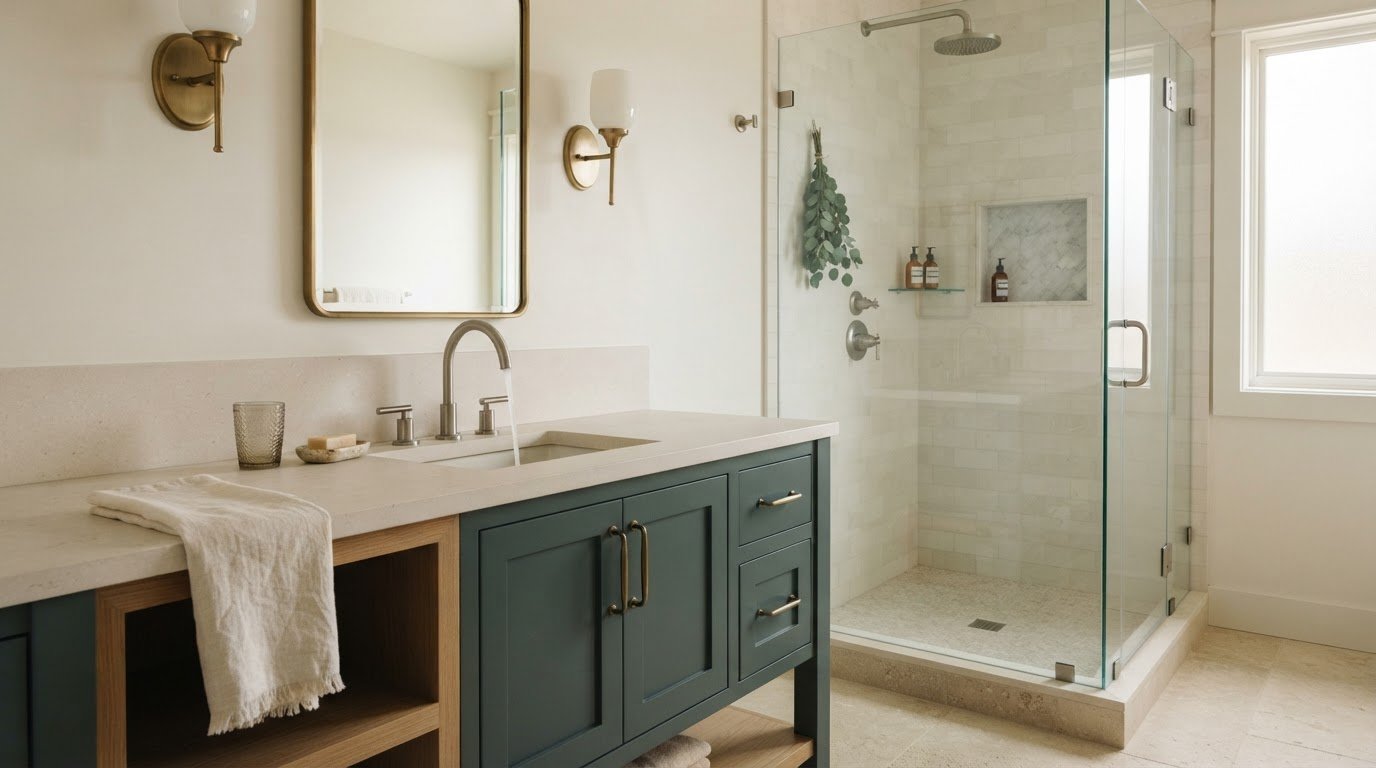
Two metal finishes are a clear starting point for mixing metals in kitchens and bathrooms: let one be the dominant finish and use the other for contrast. Two finishes work well in most rooms; a third can be added sparingly when it supports the overall palette. The aim is contrast with harmony, not a perfect match.
It’s natural to wonder whether different metals will feel intentional or out of step. Give each finish a distinct role, then repeat it thoughtfully so details feel connected throughout the room.
Learn how to pair finishes with cabinetry, counters, tile, and other materials, and whether lighting needs to match your hardware. We’ll also cover practical ways to mix metals in a bathroom, where faucets, shower fixtures, towel bars, and mirror frames can work together as a composed whole.
Key Takeaways
- Choose finishes that complement your cabinetry, counters, tile, and overall color palette, then distribute accents around the room for a more cohesive effect.
- Lighting doesn’t have to match cabinet hardware; a contrasting warm metal can add character beside cooler finishes.
- In bathrooms, faucets, shower fixtures, towel bars, and mirror frames can each help build a considered mix of metals.
- Keep paired fixtures consistent, and use finish contrast intentionally to add depth without making the room feel visually busy.
2. Pairing metal finishes with cabinetry, countertops, walls, and floors
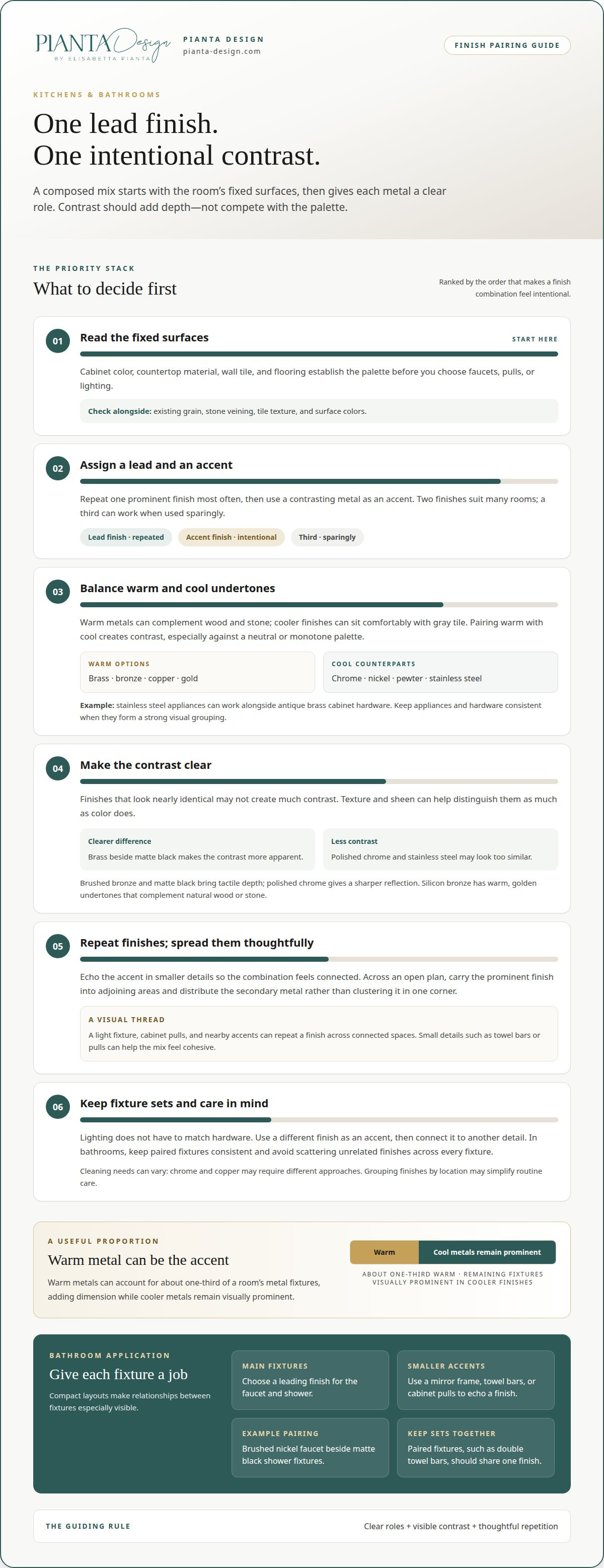
Start with the fixed surfaces: cabinet color, countertop material, wall tile, and flooring. Together, they establish the palette before you choose faucets, pulls, or lighting. Select one prominent metal finish to repeat most often, then add a contrasting finish as an accent. Two finishes suit many rooms; a third can work when used sparingly. Limiting the mix to two or three keeps the details from competing with the surfaces.
Consider undertones as well as color. Warm brass or bronze can complement wood cabinetry and stone counters, while cooler chrome, stainless steel, or nickel can sit comfortably with gray tile. Pairing a warm metal with a cool one adds contrast, especially against a neutral or monotone palette. For example, stainless steel appliances can work alongside antique brass cabinet hardware. Keep appliances and cabinet hardware consistent when they form a strong visual grouping.
Texture and sheen also help finishes work together. Brushed bronze and matte black add tactile depth, while polished chrome creates a sharper reflection. Polished chrome and stainless steel may look too similar to provide much contrast; brass beside matte black makes the difference more apparent. Silicon bronze has warm, golden undertones that complement natural wood or stone. Compare finishes with the room’s existing grain, veining, and tile texture.
How do mixed metal finishes work with different interior design styles and color palettes? They can suit contemporary, transitional, farmhouse, or industrial interiors when their tones complement the palette. White bronze, for instance, has a cooler, silvery tone that suits contemporary or transitional rooms. Repeat small accents, such as towel bars or cabinet pulls, to make the combination feel cohesive.
How can you coordinate mixed metals across an open-plan kitchen and adjoining spaces? Carry the prominent finish into connected areas, then distribute the secondary metal instead of clustering it in one corner. Repeating a finish in a light fixture, cabinet pulls, and nearby accents creates a visual thread across the open plan.
3. Do my light fixtures need to match my hardware?
No. A kitchen pendant can have a different finish from the cabinet hardware and still feel intentional. Use the fixture as an accent, then connect it to another detail, such as a door set or nearby accessory. Warm metals such as brass, copper, bronze, and gold can soften the cool appearance of stainless steel. A bronze pendant above a stainless steel range, for example, adds warmth without requiring bronze pulls throughout the kitchen.
Focus on the balance of finishes, not an exact match. Warm metals can account for about one-third of a room’s metal fixtures, adding dimension while cooler metals remain visually prominent. Chrome, nickel, pewter, and stainless steel can serve as cool counterparts. A brass light over a nickel faucet works best when the finishes are distinct and the other details support the contrast. Repeating brass in a small accessory can make the combination feel considered.
Bathroom fixtures follow the same principle, but keep each matching set consistent. A brushed nickel faucet can sit beside matte black shower fixtures, while towel bars or a mirror frame echo either finish. Another option is a matte black faucet with textured bronze hardware. Each finish should have a clear role: the faucet anchors the vanity, while the shower or accessories carry the accent. Avoid scattering unrelated finishes across every fixture.
To make the choice, identify the finish already dominant in the room, then select one contrasting metal for lighting or accessories. Check how both finishes look beside the faucet, cabinet hardware, and the room’s surface colors. Kitchen lighting and door sets can introduce warmth without competing with the main hardware. For a more complete plan, residential interior design can bring lighting, fixtures, and finishes into one cohesive scheme.
4. Mixing metals in bathrooms
A bathroom’s compact layout makes the relationship between fixtures especially visible. Choose a leading finish for the faucet and shower, then assign a secondary metal to smaller details. A mirror frame, towel bars, or cabinet pulls can add accents without competing with the main fixtures. This gives each metal a purpose and keeps the vanity, shower, and storage visually connected.
For contrast, combine finishes that look distinct at a glance. Polished chrome has a bright, reflective presence, while matte black creates a quieter, graphic accent. A brushed nickel faucet beside matte black shower fixtures is one example; a matte black faucet with textured bronze hardware is another. Keep paired fixtures, such as double towel bars, in one finish so they read as a deliberate set.
In a bathroom, surface texture matters as much as color. Matte and brushed finishes can reduce the visibility of fingerprints and water spots on shower fixtures, while polished surfaces create sharper highlights. Consider the stone, tile, and glass: a heavily veined countertop may call for simpler metal details, while plain tile can accommodate a more pronounced accent. Compare samples beside the actual surfaces.
Consider care when selecting finishes. Chrome and copper can require different cleaning approaches, so grouping finishes by location may simplify routine care. For example, use a polished finish at the vanity and a brushed finish in the shower, then repeat one of those metals in a mirror frame. In an open bathroom suite, a consistent accent can also connect the vanity to nearby cabinetry.
What are common mistakes when mixing metals in a kitchen or bathroom? Using too many finishes, choosing metals that look nearly identical, and clustering each finish in a separate area can weaken the composition. In a bathroom, avoid splitting a matching fixture set across finishes or choosing polished details without considering the surrounding tile and stone. Give each metal a role, then repeat it thoughtfully.
4. What are the rules for mixing metal finishes in kitchens and bathrooms?
Use two finishes as your starting point. Choose one primary metal for about two-thirds of the fixtures, then reserve the second for the remaining third. This gives the room a visual anchor while preserving contrast. In a kitchen, the primary finish might appear on cabinet pulls and a faucet, with the second on pendants and smaller accents. This balance is a useful foundation for mixing metals in kitchens and bathrooms.
Two finishes create a composed mix in most rooms. If you’re new to mixing metals, start with two and see how the tones interact. A third can work as a restrained accent when it has a clear role. Across a home, keep the palette to two or, at most, three finishes. That continuity can connect an open-plan kitchen with adjoining spaces without making every fixture identical.
Cool metals such as chrome, stainless steel, nickel, and pewter can act as adaptable neutrals. Pair one with warmer brass or bronze for visible contrast. The finishes should look distinct while complementing the cabinetry, counters, tile, and overall color palette. A neutral or monotone scheme lets contrasting metals stand out without crowding the visual field. These principles make mixing metals in kitchens and bathrooms feel intentional rather than arbitrary.
Keep matching fixture sets consistent. If a vanity has two faucets or a bathroom uses double towel bars, choose the same finish for each pair. Then repeat the secondary metal elsewhere rather than concentrating every accent in one area. For example, echo a bronze light in a nearby mirror frame or cabinet pull. Repetition links the details, while thoughtful distribution carries that connection across the room.
Before selecting finishes, map the main fixtures and accents, then compare the arrangement with the fixed surfaces. This reveals whether one metal dominates and whether the contrast feels balanced. For a considered palette tailored to your room, explore material and finish selection.
Pianta Design: Residential Interior Design
Pianta Design brings mixed-metal schemes into focus through Residential Interior Design, connecting finishes with your home’s character and function. Turn to the team when choosing faucets, cabinet hardware, lighting, and surface materials feels like a series of separate decisions rather than one considered composition.
Residential Interior Design can shape the wider room around those details, while Lighting Design helps fixtures contribute to the intended atmosphere. For a renovation or new interior, Interior Architecture can also align spatial decisions with the finish palette. The aim is a coherent design in which contrast feels deliberate and every material belongs.
To discuss your home and its design direction, contact Pianta Design.
Shape a Finish Palette That Feels Like Home
Treat the finish palette as part of how a room supports daily life, not as a final layer chosen in isolation. The right combination responds to the light, surrounding materials, and how the household uses the space. This makes mixing metals in kitchens and bathrooms a considered design decision, creating character that belongs to the home rather than a passing trend.
Pianta Design can carry that intention through a broader project with Residential Interior Design, Commercial Interior Design, and Custom Furniture Design. When finishes need to relate to furniture, lighting, and architecture, a unified direction helps each choice reinforce the next.
Share your vision and contact Pianta Design to plan your finishes. Begin with the atmosphere you want to create, and let each material contribute to a space that feels distinctly yours.
Frequently Asked Questions
How many metals should I use in one room?
Start with two metals, especially if you’re still deciding how the room should feel. This gives you room to compare warm and cool tones without adding too many competing details. For example, try one finish on the main plumbing fixtures and another on a pendant or cabinet pulls. Consider the fixed surfaces before adding another metal, since stone and tile already contribute color and pattern.
Do my light fixtures need to match my hardware?
No. A light fixture can have a different finish from cabinet hardware and still look intentional. Consider its scale and visibility: a sculptural pendant makes a stronger statement than a small recessed light. If the pendant has a distinctive bronze finish, echoing that tone in a nearby accessory can connect it to the rest of the room without requiring matching hardware.
How do I know whether a room needs more contrast or more consistency?
Notice whether the room’s finishes compete or blur together. If patterned tile, veined stone, and several metals all draw attention, simplify the metal choices. If pale cabinetry and understated surfaces feel too uniform, a contrasting finish on one focal detail can add definition. In a kitchen, consider whether a pendant or faucet could give the eye a clear point of interest.
What is the easiest way to experiment with mixed metals without committing?
Place finish samples beside the actual cabinet, countertop, and tile materials, then view them at different times of day. Natural and artificial light can change how a polished surface reflects nearby colors. You can also test the palette with movable accents, such as a tray or small frame. Photograph the combinations from the doorway to see how they read across the room.
How many different metal finishes should you use in one room?
Two finishes are a dependable starting point; a third can work as a small, repeated accent. Keep the main fixtures visually related, then use an additional tone on a limited detail, such as a mirror frame. This approach to mixing metals in kitchens and bathrooms adds variety without letting minor accessories compete with larger design elements.
Which metal finishes pair well together, such as brass, chrome, nickel, and black?
Brass can contrast with matte black, while chrome and nickel provide cooler counterparts to warmer metals. In a kitchen, brass accents can add warmth beside stainless steel appliances. In a bathroom, a nickel faucet and black shower fixtures create a distinct pairing. When mixing metals in kitchens and bathrooms, compare finishes with the room’s fixed materials and lighting before settling on a combination.
