
The Art of Space Planning: Designing High-Performance Luxury Interiors in San Francisco, Miami, and Park City
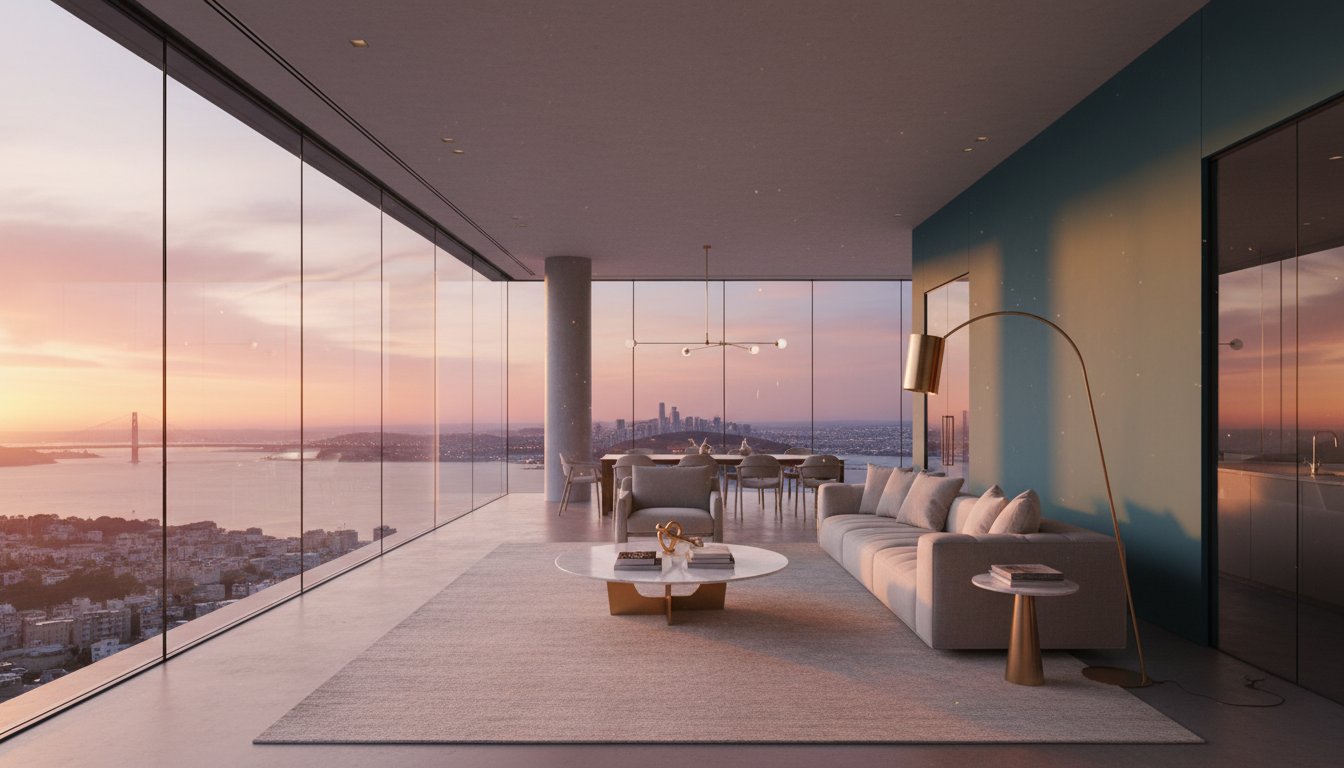
The most expensive element in a luxury penthouse isn't the hand-carved marble or the custom lighting; it's the 18% of square footage that remains functionally invisible because of poor layout choices. You've likely invested years into acquiring iconic furniture and selecting the finest textures, only to find that your living area feels oddly cluttered or disconnected from the horizon. It's a common frustration for homeowners who realize that beautiful objects don't automatically create a beautiful life. Expert space planning is the invisible thread that weaves these individual elements into a cohesive narrative of comfort and prestige.
You're about to discover how professional space planning transforms high-end residences into choreographed masterpieces of flow, function, and Italian-inspired elegance. We'll show you how to eliminate wasted corners while maximizing those breathtaking 180-degree views of the Bay or the mountains. This guide explores the delicate dance between architectural constraints and interior decor, ensuring your home flows naturally between social energy and private serenity. By the end, you'll understand why the most successful interiors aren't just seen; they're felt through the perfect balance of volume and light.
Key Takeaways
- Learn why the most exquisite interiors begin with the analytical organization of spatial relationships before a single aesthetic choice is made.
- Discover the art of "spatial choreography" to balance vibrant social engagement with intimate private sanctuary through invisible circulation paths.
- Understand how to navigate complex architectural footprints, from maximizing light in historic San Francisco homes to achieving breathable layouts in Miami penthouses.
- Explore the professional space planning process that translates your unique lifestyle rituals into a technical blueprint for effortless living.
- See how three decades of expertise in high-end residential and yacht design ensure your home transcends mere utility to become a choreographed masterpiece.
What is Space Planning? Defining the Foundation of Interior Excellence
Space planning represents the rigorous, analytical choreography of spatial relationships and circulation patterns within a home. It's the silent force that determines how you experience a room before a single piece of velvet or marble enters the frame. At Pianta Design, this process isn't a secondary consideration; it's the mandatory precursor to every aesthetic decision. We don't just fill rooms with beautiful objects. We optimize volumes to ensure every square inch serves a purpose, reflecting a lifestyle of effortless sophistication.
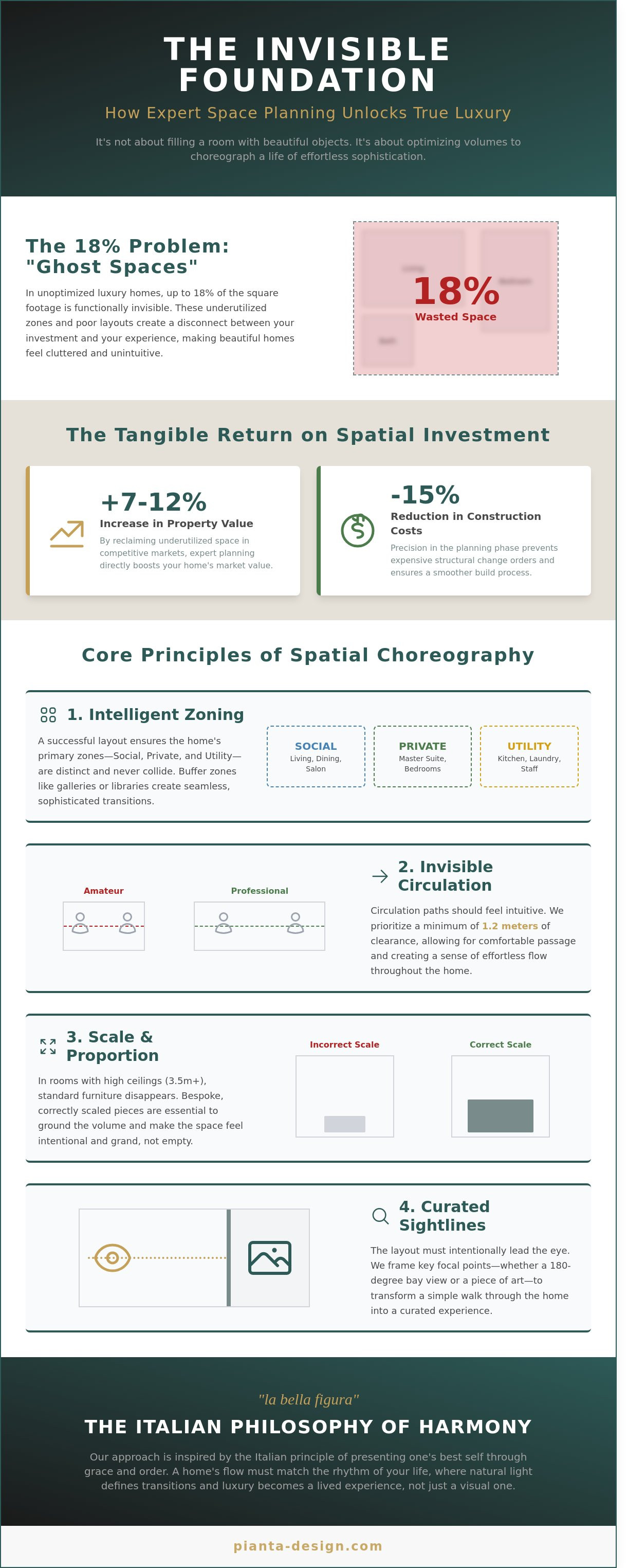
In high-end residential design, the distinction between "filling a room" and "optimizing a volume" is the difference between a house and a masterpiece. Amateur layouts often result in "ghost spaces," which are underutilized zones that account for up to 18% of a home's square footage in unoptimized floor plans. Professional space planning eliminates these dead zones, ensuring the flow of movement feels intuitive rather than forced. It's about the invisible lines of sight and the physical ease of moving from a quiet morning ritual to an evening of grand entertaining.
The Interplay of Interior Architecture and Planning
Structural elements like load-bearing columns and floor-to-ceiling windows aren't obstacles; they're the rhythmic markers that dictate a home's flow. Our approach integrates Interior architecture as the foundational skeleton. We've shifted the focus from static 2D floor plans to complex 3D spatial volumes, treating the air between the walls as a tangible material to be sculpted. This ensures the bones of the house support the soul of the design.
The ROI of Expert Planning
Precision in the early stages yields financial dividends. In competitive markets like San Francisco, where luxury real estate averages $1,200 per square foot, reclaiming underused space directly increases property value by 7 to 12 percent. Beyond market value, expert space planning saves approximately 15% of total construction costs by preventing expensive structural change orders once building has commenced. A home that's planned with foresight adapts to your evolving lifestyle, ensuring its relevance for decades.
The Principles of High-End Spatial Choreography
Mastering high-end space planning requires more than an eye for aesthetics; it demands an architectural understanding of human behavior. Designers often categorize layouts into three primary zones: social engagement, private retreat, and utility. A successful floor plan ensures these areas never collide. For instance, a professional-grade kitchen should be accessible for catering staff without crossing the path of guests in the formal dining room.
Circulation acts as the home's nervous system. In luxury residences, we prioritize "invisible paths" that provide at least 1.2 meters of clearance, allowing two people to pass comfortably without breaking conversation. This sense of ease is amplified by scale and proportion. When ceilings reach 3.5 meters or higher, bespoke furniture must be scaled up to ground the room. A standard-sized sofa disappears in such a volume; it needs the weight of a custom 4-meter modular piece to feel intentional.
Sightlines serve as the final layer of choreography. Whether it's framing a 180-degree sunrise over Miami’s Biscayne Bay or the jagged peaks of Park City, the layout should lead the eye toward these focal points the moment a door opens. This intentionality transforms a simple walk through the house into a curated gallery experience.
Balancing Social and Private Zones
The distinction between the "Public Path" and the "Private Path" is a hallmark of sophisticated living. We design buffer zones, often using library galleries or art-filled corridors, to separate grand entertaining spaces from master suites. Acoustic planning plays a critical role here. By utilizing 15mm thick acoustic underlays and strategic cabinetry placement, we ensure a lively cocktail party in the salon doesn't disturb the tranquility of the sleeping quarters.
The Italian Influence: Harmony and Dolce Vita
Our approach draws heavily from "la bella figura," the Italian philosophy of presenting one's best self through grace and order. This isn't just about appearance; it's about how a home feels. We use natural light as a primary tool to define transitions, following the sun's path to energize morning breakfast nooks and soften evening lounges. This alignment between spatial harmony and the resident's well-being is at the heart of our curated design philosophy. When a home’s flow matches the rhythm of the soul, luxury becomes a lived experience. Through expert space planning, we don't just build rooms; we orchestrate a lifestyle that feels both effortless and deeply personal.
Navigating Regional Design Challenges: From SF Victorians to Miami Penthouses
True luxury is never a template; it's a visceral response to the environment. A designer's approach to space planning must shift as radically as the climate when moving from the fog-draped hills of Northern California to the sun-drenched coast of Florida. Each geography dictates its own set of rules, requiring a mastery of both local building codes and the natural rhythm of the landscape.
San Francisco & the Bay Area: Historic Modernization
In San Francisco's Pacific Heights or Presidio Heights, we often work within the rigid, vertical constraints of 1890s Victorian footprints. These homes sit on narrow 25-foot-wide lots where light is the most precious commodity. Effective space planning in these historic shells involves a surgical approach to internal structures. We often replace heavy, compartmentalized walls with steel moment frames to create a "telescoping" effect. This allows the eye to travel from the front parlor directly to the rear garden, making a 3,500-square-foot home feel twice its actual size. Modernizing these spaces requires navigating the San Francisco Planning Department's strict preservation guidelines while integrating 21st-century seismic retrofitting and open-concept flow.
Miami & South Florida: The Waterfront Aesthetic
Miami's luxury market is defined by the high-rise penthouse, where the horizon serves as the primary artwork. The layout here revolves around the "Great Room" concept, often spanning over 1,500 square feet of uninterrupted floor space. We choreograph the transition from the interior to the 10-foot-deep terraces using flush-track sliding glass systems. This eliminates the physical threshold between the salt air and the climate-controlled living area. Materiality is crucial; we select non-porous stones and treated woods that remain stable in 85% humidity. The goal is a seamless, breathable environment where the Atlantic Ocean feels like an extension of the sofa.
Park City & Utah: Mountain Contemporary Layouts
Designing for the Wasatch Range requires managing immense volumes. In Park City’s ski-in/ski-out estates, 20-foot vaulted ceilings can easily feel cavernous and cold. We anchor these sprawling 8,000-square-foot layouts with 15-ton stone hearths that act as the home's spiritual and thermal center. Specialized utility is a hallmark of Utah mountain design:
- High-performance mudrooms: Integrated lockers for $5,000 ski setups and heated boot drying systems.
- Entertainment hubs: Climate-controlled wine cellars and tiered home theaters for après-ski relaxation.
- The Heart of the Home: Oversized kitchens with dual islands to accommodate large family gatherings.
In Salt Lake City, we see a different trend. There's a 30% increase in requests for "invisible" additions to 1930s bungalows. These projects preserve the traditional residential roots of neighborhoods like Harvard-Yale while doubling the living space through modern, glass-heavy rear expansions that respect the original streetscape.
The Professional Space Planning Process: From Concept to Blueprint
Creating a luxury interior requires more than an eye for beauty; it demands a rigorous, multi-staged methodology that bridges the gap between a client's soul and the physical structure. This transition from abstract desire to a technical space planning blueprint is where the invisible becomes tangible. We treat every square meter as a precious resource, ensuring the final layout feels inevitable rather than forced.
Step 1: The Discovery & Lifestyle Audit
We begin by deconstructing your daily existence. We don't just ask about room counts; we ask how the light should greet you at 7:30 AM or how you prefer to transition from a high-stakes boardroom environment to a private evening sanctuary. We map the movements of every family member to prevent "spatial friction" in high-traffic areas. The lifestyle audit serves as the essential foundation of every Pianta project, translating personal values into physical boundaries.
Step 2: Bubble Diagrams and Adjacency Matrices
Before a single line is drawn in CAD, we utilize bubble diagrams to visualize the home's energetic flow. This stage focuses on "adjacencies," determining which functions must coexist and which require total acoustic isolation. We identify primary focal points, such as a 4-meter wide panoramic view or a bespoke art installation, ensuring the "loose sketch" honors these anchors. This process eliminates common architectural errors, such as placing a formal dining area too far from the staging kitchen.
Step 3: Technical Drafting and 3D Modeling
Precision is the hallmark of luxury. Our team spends upwards of 60 hours on the initial technical planning package, using advanced software to simulate natural light infiltration across different seasons. We account for the exact dimensions of custom Italian furniture pieces during the drafting phase. Every millimeter is scrutinized.
- Scale Testing: Ensuring a 3-meter modular sofa maintains a 90-centimeter clearance for effortless movement.
- Visual Symmetry: Aligning ceiling coffers with floor patterns to create subconscious harmony.
- Technical Integration: Mapping hidden HVAC and smart-home nodes within the 3D model to avoid site-day surprises.
The final phase involves a collaborative review with master contractors and manufacturers in regions like Brianza, Italy. We refine the plan until every custom joinery piece fits the planned choreography perfectly. This meticulous oversight ensures that when you finally step into your completed home, the space feels like it was grown around your specific needs. Experience how we transform your vision into a meticulously planned luxury interior that stands the test of time.
Elevating Your Lifestyle Through Expert Interior Architecture
Luxury isn't a collection of expensive objects; it's the invisible logic that dictates how you move through your home. "Good enough" planning often results in 15% of floor space becoming unusable because of poor circulation or mismatched scales. At Pianta Design, we've spent 30 years perfecting the intersection of architecture and lifestyle, moving beyond mere decoration to master the art of space planning. Our portfolio spans three decades of high-end residential estates and luxury yachts, where every square inch must justify its existence through both beauty and utility. We manage the complex logistics of your project so you can focus on the evolution of your vision. Professional project management ensures that your timeline remains intact and your stress levels remain low.
The Synergy of Planning and Procurement
Our deep-rooted relationships with 25 boutique Italian manufacturers allow us to design with the final piece of furniture in mind. We don't just pick a chair; we coordinate with artisans in Brianza to ensure the upholstery's texture complements the room's natural light. This integrated approach ensures that custom furniture acts as the final anchor in a perfectly executed spatial puzzle. Every material and finish is selected to enhance the planned flow, creating a cohesive narrative from the floorboards to the ceiling coves.
Starting Your Design Journey
Your initial consultation with Pianta Design serves as the blueprint for your future environment. We currently serve discerning clients across Northern California, Florida, and Utah, bringing a global perspective to local landscapes. During this first meeting, we'll discuss your daily rhythms and aesthetic aspirations to create a home that functions as a sanctuary. You can expect a detailed overview of how space planning will transform your current floor plan into a masterpiece of efficiency and elegance. A well-planned home isn't just a physical structure; it's a 20% increase in your daily sense of well-being and a permanent investment in your quality of life.
Begin Your Journey Toward Architectural Harmony
True luxury begins long before the first piece of furniture arrives. It starts with the invisible lines of space planning, a discipline that dictates how you move, breathe, and interact within your private world. You've discovered how the right layout balances aesthetic grandeur with functional precision. It bridges the gap between a structure and a sanctuary that reflects your soul. Every corner of your environment should serve a purpose while inspiring a sense of effortless grace.
Pianta Design draws on over 30 years of high-end design experience to master this delicate dance. We've cultivated exclusive partnerships with premier Italian manufacturers to ensure every texture and proportion meets our exacting standards. Our team delivers bespoke solutions for residential estates, luxury yachts, and prestigious commercial spaces. We don't just decorate rooms; we curate experiences that stand the test of time through meticulous craftsmanship and an unwavering commitment to quality. Your vision deserves a foundation built on expertise and passion.
Schedule Your Complimentary Design Consultation
Let's transform your surroundings into a living masterpiece that celebrates your unique lifestyle.
Frequently Asked Questions
How much does a professional space planning consultation cost?
Consultation fees for luxury projects typically range from $250 to $750 per hour; alternatively, a flat fee starting at $2,500 for a single room is common. High-end firms often bill 10% to 15% of the total project value for comprehensive planning services. This investment ensures every square inch aligns with your lifestyle before you purchase a single piece of furniture. It's a small price to pay for the long-term harmony of your home.
Is space planning different for a yacht compared to a residential home?
Yacht planning requires a 30% higher focus on weight distribution and movement stability compared to fixed land structures. Marine environments demand that every element is secured and multi-functional to withstand 5-degree shifts in balance. While a home prioritizes static flow, a yacht requires precision engineering for compact, curved hulls where 100% of the furniture must be integrated into the vessel's architecture. It's a specialized discipline that marries naval engineering with aesthetic grace.
Can I do my own space planning with online software?
You can use consumer-grade tools like SketchUp or Roomstyler, but they lack the 0.5mm precision required for bespoke luxury installations. Professional space planning involves complex calculations regarding light refraction, acoustic dampening, and ergonomic clearances that basic software ignores. While 65% of homeowners try DIY apps, they often miss technical details like HVAC duct placement or load-bearing limitations that professional designers identify instantly. True luxury requires a level of detail that algorithms can't yet replicate.
How long does the space planning phase typically take in a luxury project?
The initial phase usually spans 4 to 8 weeks depending on the property's scale. This period includes site measurements, 3D modeling, and at least 3 rounds of iterative feedback to perfect the flow. For a 5,000 square foot residence, expect the detailed layout and technical drawings to require approximately 120 hours of dedicated design time. This deliberate pace ensures the final result feels effortless and intuitive rather than rushed.
What is the difference between a floor plan and a space plan?
A floor plan is a 2D technical map of walls and windows, while a space plan is a 3D strategic analysis of how you actually inhabit those rooms. Professional space planning dictates the choreography of movement, ensuring that a 36-inch clearance is maintained around dining tables and that sightlines align with architectural focal points. It's the difference between seeing a house on paper and feeling the rhythm of a home in practice. One is a blueprint; the other is a lifestyle strategy.
Should I hire an architect or an interior designer for space planning?
You should ideally hire both, as 85% of successful luxury builds result from a collaboration where the architect handles the shell and the designer optimizes the interior experience. Architects focus on the structural integrity and 12-foot ceiling heights, while designers specialize in the human-centric scale of the furniture and lighting. This partnership prevents common errors where a room's proportions don't match its intended social function. Together, they create a seamless transition between the exterior and interior worlds.
How does space planning affect my lighting and electrical needs?
It serves as the blueprint for your entire electrical map, determining the placement of floor outlets and 5-channel lighting scenes. If your layout isn't finalized, you'll likely place a $5,000 chandelier 2 feet off-center from your dining table. A precise plan ensures that 100% of your task and ambient lighting aligns with the furniture's final position. This eliminates the need for unsightly extension cords and ensures your art is illuminated from the perfect angle.
Can space planning help if I have a small or awkwardly shaped room?
It's the most effective tool for reclaiming 20% to 30% of usable area in unconventional layouts. By utilizing custom-built cabinetry and strategic focal points, a designer can turn a 45-degree corner into a purposeful reading nook or a hidden bar. Professional techniques like "zoning" allow a single 200-square-foot room to function as both a private office and a sophisticated lounge without feeling cluttered. Even the most challenging angles can be transformed into elegant assets through intelligent design.
