

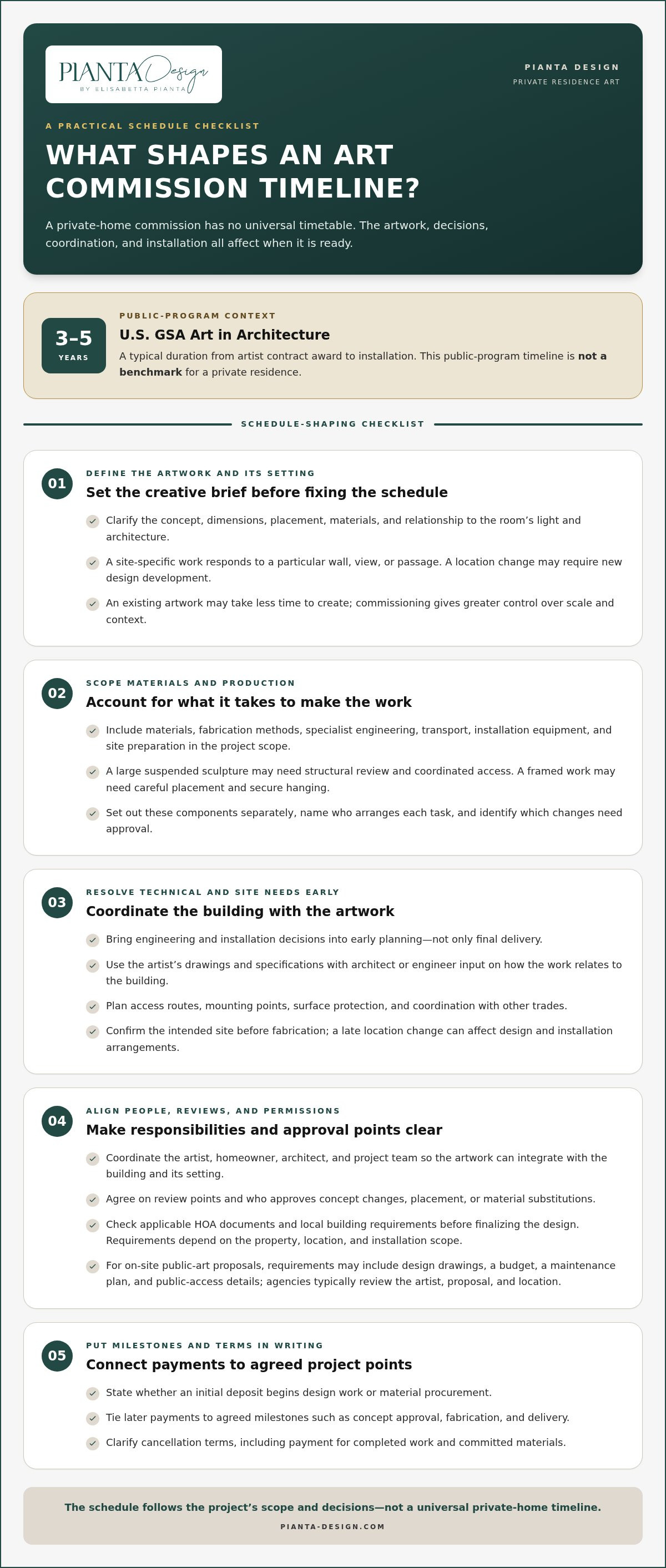
A private-residence art commission has no universal timetable. Its duration depends on the artwork, approvals, materials, and installation needs. For context, a U.S. General Services Administration Art in Architecture commission typically takes three to five years from contract award to installation, but that public-program timeline is not a standard for a private home. Art commissioning for a private residence follows the scope and decisions of each project.
It is natural to want a clear sense of timing before shaping a room around a singular work. A thoughtful commission involves more than creating the artwork: design development, coordination, and installation all influence when it will be ready to live with.
This article explains the stages that shape the schedule, who typically contributes at each point, and how commissioning on-site art compares with paying a fee in programs that offer that choice. It also covers how scale, setting, and review processes shape the journey from the initial idea to the finished work.
Key Takeaways
- Build the schedule around the artwork’s scale, materials, engineering needs, approvals, and installation conditions, not just the time required to create it.
- Clear coordination between the artist, architect, and project team helps integrate the work with the building and its setting.
- Understand how public-art program requirements can shape timelines differently from a private residential commission.
- Compare an approved on-site artwork with an in-lieu fee by considering the project’s goals, review process, and ongoing care responsibilities.
- Use the commission contract to clarify scope, milestones, payment terms, revisions, installation, and rights to the finished work.
How long is the artwork commission process?
There is no single schedule for a private residence: the work’s scale, materials, approvals, and installation shape the timeline. For comparison, a U.S. General Services Administration Art in Architecture commission typically takes three to five years from artist contract award to installation. That public-program duration is not a private-home benchmark. A custom painting, wall relief, or sculptural installation involves different decisions and production needs.
The first stages define what the artwork should accomplish in its setting. The artist and homeowner clarify the concept, dimensions, placement, materials, and relationship to the room’s light and architecture. A site-specific work responds to a particular wall, view, or passage, so changing the location can require new design development. An existing artwork may take less time to create, while a commission allows greater control over scale and context.
Artwork costs reflect more than the artist’s creative work. Materials, fabrication methods, specialist engineering, transport, installation equipment, and site preparation all affect the project budget. A large suspended sculpture, for example, may need structural review and coordinated access, while a framed work may require careful placement and secure hanging. Set out these components separately in the proposal, including who arranges each task and which changes require approval.
Engineering and installation decisions belong early in the schedule, not at final delivery. The artist can provide drawings and specifications, while an architect or engineer can assess how the work relates to the building. The installation plan should address access routes, mounting points, surface protection, and coordination with other trades. For a site-specific piece, confirm the intended location before fabrication, since a late change may affect the design and installation arrangements.
Are there local permits, HOA rules, or building restrictions for residential art installations? Requirements depend on the property, location, and installation scope. Review applicable HOA documents and local building requirements before finalizing the design. A freestanding work may raise different considerations from an exterior attachment or a suspended piece that affects the building structure.
Public access also changes the proposal. On-site public-art proposals may require design drawings, a budget, a maintenance plan, and details of public access; agencies typically review the artist, proposal, and location. A private home generally has a different audience and approval context, but access still matters when a work sits near an entry, shared area, or visible exterior. The work’s suitability depends on how well it fits its setting, materials, scale, and intended experience.
How do artist deposits, milestone payments, and cancellation terms work? The contract should state whether an initial deposit starts design or material procurement, then tie later payments to agreed milestones such as concept approval, fabrication, and delivery. It should also explain cancellation, including payment for completed work and committed materials.
Responsibilities of artists, architects, and agencies
A successful commission depends on clear responsibilities, from the artist’s creative decisions to the project team’s technical coordination. Public agencies add formal selection and review processes that differ from private residential work.
Artist Engagement in Design
Artist engagement means involving the artist in design coordination rather than treating the artwork as a final decorative addition. Artists with U.S. General Services Administration commissions work with project architects and others as members of a design team, integrating their work into the project. This collaboration matters because placement, structure, lighting, and architectural details can shape the artwork itself.
For example, an artist designing a wall-integrated relief can coordinate its dimensions and mounting requirements with the architect’s drawings. The architect can identify relevant building conditions while the artist develops the work’s form and materials. Agreeing on review points helps the homeowner understand which decisions need approval and when technical input should be incorporated.
Artist Selection and Agency Approval
Artist selection is the process of choosing an artist for a project; agency approval is the responsible public body’s review of the artist, proposal, and location. These steps matter because public commissions can involve formal evaluation beyond the homeowner’s preferences. On-site public-art proposals may require design drawings, a budget, a maintenance plan, and details of public access.
For U.S. General Services Administration Art in Architecture commissions, the artist candidate pool includes National Artist Registry candidates and responses to contract opportunities on SAM.gov. The agency’s review differs from a private residence’s selection process, where the owner and project team align on artistic intent and practical fit. Defining who approves each decision prevents uncertainty about concept changes, placement, or material substitutions.
Artist and Project Definitions
An artist is the creator responsible for the proposed artwork; a project is the defined commission, including its scope, site, intended use, and review process. Clear definitions matter because public programs and private commissions may assign different responsibilities. A site-specific sculpture, for instance, depends on its approved location, while a movable painting can be considered separately from the room’s construction.
For a public-art commission, the agency may establish the project brief and review stages while the artist develops the proposal. In a private home, the owner’s goals and the architect’s plans help frame the commission. Naming the artwork, site, deliverables, and decision-makers in project documents gives each participant a shared reference.
Art Commission Contract Terms
An art commission contract records the agreed scope, responsibilities, schedule, payment milestones, installation arrangements, and ownership terms. It matters because creative approval and technical delivery are related but distinct obligations. Specify the approved concept, materials, dimensions, revisions, transport, installation, and the process for addressing delays or changes.
Rights also deserve precise attention. Federal Visual Artists Rights Act provisions apply to property owners and developers in connection with public art; the law is identified at Title 17, Chapter 1 of the United States Code Annotated. According to the U.S. Government Publishing Office, copyright owners hold the exclusive rights to reproduce a work and prepare derivative works based on it. A written agreement should distinguish ownership of the physical artwork from copyright permissions.
When a commission must harmonize with a room’s lighting, finishes, and architectural details, residential interior design can help coordinate those elements with the artwork’s setting.
Commission timelines
A commission’s schedule is shaped by decisions as much as by fabrication. In a private residence, concept development, approvals, technical coordination, and installation form connected stages. The artwork’s scale, materials, location, and relationship to construction determine which stages need the most attention. The timeline for art commissioning for a private residence is best understood through its decision points, rather than a generic duration.
For comparison, a U.S. General Services Administration Art in Architecture commission typically takes three to five years from artist contract award to installation of the completed artwork. This public-program duration is not a standard for private homes. Its formal selection, proposal development, project coordination, and agency review create a different sequence from a homeowner’s commission.
The process starts with a brief that identifies the room, intended atmosphere, and artwork’s role. The artist develops a concept for the chosen setting, then the homeowner reviews its scale, materials, and visual direction. A work conceived for a particular wall, stairwell, or courtyard depends on that location. Confirming the site before final design helps avoid revisiting dimensions or composition later.
Design coordination can begin while architectural plans are still developing. For example, an artist working on a built-in relief can align its dimensions with the wall design before finishes are selected. This timing connects artistic choices with the room’s proportions and construction details. It also gives the project team a shared reference for decisions about the artwork’s integration.
Approvals influence the schedule because each review may lead to refinements. A homeowner might approve the concept first, then review a material sample or a more developed drawing before fabrication. Agreeing on who makes each decision and what information they need keeps feedback focused. For art commissioning for a private residence, clear approval points help the artist progress without relying on informal or conflicting direction.
Technical development follows the design decisions that affect fabrication. A sculptural work may need engineering input, mounting details, or coordination with the building team. A painting may involve fewer structural considerations, yet framing, delivery access, and placement still require planning. Materials and fabrication methods also shape the sequence, since specifications need to be settled before the artist can proceed confidently.
Installation depends on site readiness as well as the artwork’s completion. A large piece may require an access route, prepared mounting points, and coordination with other work in the residence. If the room is being renovated, its completion and access conditions affect installation planning. Clarifying these dependencies early connects delivery with the site’s actual readiness.
Map the project from brief approval through concept review, technical coordination, fabrication, site preparation, and installation. For each stage, identify the decision-maker and any prerequisite, such as an approved drawing or completed wall. This gives the homeowner and artist a practical way to track progress, recognize dependencies, and make considered decisions as the commission develops.
Paying a fee versus commissioning on-site art
Some U.S. public-art programs let a developer provide approved artwork on-site or make an in-lieu contribution. The choice depends on the local program, not on a universal rule for private residences. For homeowners, the distinction matters when a property is part of a development subject to an art requirement. A fee contributes to a program; an on-site commission creates a work intended for a particular place.
Miami-Dade County’s Art in Public Places program allocates 1.5% of the construction cost of new county buildings to art. This applies to county buildings, not automatically to private homes or private development. It illustrates how a public program may connect an art allocation to construction costs. Always distinguish a government building requirement from an obligation that applies to a privately owned residence.
Some percent-for-art programs offer private developers a choice between paying a fee and providing approved artwork on-site. These routes serve different purposes. An in-lieu contribution supports the designated public-art fund, while an on-site work places art within the development for residents or visitors to encounter. Program rules define the available options, approval process, and any conditions tied to the contribution or artwork.
On-site commissioning makes the artwork part of the project’s design and delivery. The proposal may need review of the artist, artwork, and location before it proceeds. The project team must also coordinate the work with the site, access, and construction schedule. A fee avoids commissioning and installation decisions, but it does not result in a work created for that particular setting.
Consider the responsibilities that continue after installation. An on-site work may require maintenance and conservation, and the property owner can have ongoing duties under the relevant program. The artwork’s materials, location, and exposure influence the care it needs. A contribution does not create an object on the property, so it does not bring the same site-specific maintenance considerations.
Public programs also differ by funding source and project type. The U.S. General Services Administration reserves 0.5% of the estimated construction cost of each new federal building or modernization for an Art in Architecture commission. That federal allocation is not a private-home requirement. It demonstrates why the governing program, ownership, and type of construction must be understood before comparing payment with an on-site commission.
For a residence, first determine whether a public-art program applies to the property or development. Then compare what each permitted route means for the project: a contribution to a fund, or an artwork integrated into the site. Consider the desired experience, review process, installation needs, and future care. The decision rests on the applicable program and whether a lasting work at the property serves the project’s aims.
What should an art commission contract include?
A clear contract turns an artistic brief into shared expectations for the artist and homeowner. It should identify the artwork, location, deliverables, decision-makers, payment schedule, and completion conditions. For example, a commission for a painted wall panel should distinguish the panel itself from its delivery, mounting, and any site preparation.
Define the scope precisely. Record the concept or approved reference, dimensions, materials, finish, intended location, and whether the work is site-specific. Attach drawings or visual references when they clarify the agreement. State what the artist will deliver, such as a finished sculpture, installation drawings, or care instructions. If the homeowner requests a material or size change, describe how both parties approve the revision and its effect on the schedule.
Set out the approval stages and responsibilities. A contract can name the person authorized to approve sketches, prototypes, and the final work. It should also clarify who coordinates with the architect, engineer, installer, or building team. For a suspended piece, for instance, specify who supplies mounting details and who approves the building connection. This helps separate artistic decisions from technical coordination.
Make payment terms clear and put them in writing. State the total commission fee, any initial deposit, the milestones that trigger later payments, and the final payment condition. Possible milestones include concept approval, fabrication progress, and delivery. Cancellation terms should explain how the parties handle completed work, materials already ordered, and outstanding payments. Include a process for documenting schedule changes or other agreed amendments.
Address transport, installation, and care as distinct responsibilities. Identify who arranges packing, delivery, access to the residence, mounting, and protection of nearby surfaces. For a work requiring specialist installation, the contract should identify the responsible party and any preparations required at the site. Include acceptance criteria, such as inspection for damage after delivery, and provide maintenance guidance appropriate to the specified materials.
Ownership and copyright require separate wording. The buyer may own the physical artwork without receiving every copyright permission. According to the U.S. Government Publishing Office, copyright owners hold the exclusive rights to reproduce a work and prepare derivative works based on it. The contract should state which uses are permitted, such as photographing the work for personal records, and whether reproduction or adaptation requires written permission. For public art, federal Visual Artists Rights Act provisions apply to property owners and developers in connection with public art; the law is identified at Title 17, Chapter 1 of the United States Code Annotated.
Before signing, review the brief, attachments, payment milestones, installation duties, cancellation wording, and rights together. Discuss residential interior design to coordinate an artwork’s placement with the room’s architecture, finishes, and lighting.
Pianta Design: Residential Interior Design
Pianta Design’s Residential Interior Design helps bring commissioned art into a home’s wider composition, aligning its placement with the architecture, furnishings, finishes, and lighting. Turn to the service while planning a renovation or shaping a room around a new work, so the artwork and its setting can be considered together rather than as separate decisions.
For example, a floor plan can clarify how a sculpture relates to circulation, while mood boards and 3D visualizations help assess how a painting’s scale and palette sit within the room. This thoughtful coordination supports a cohesive interior without diminishing the artwork’s individual character.
If you’re planning a home around a commissioned piece, contact Pianta Design or visit pianta-design.com.
Shape a home around the art you want to live with
The next step is to picture how the artwork will feel in daily life, beyond the moment it is installed. Consider the view from a favorite chair, the changing light across a surface, and how the piece relates to the rooms you move through each day. These choices can make art commissioning for a private residence a considered part of shaping a home’s character.
Pianta Design brings that wider perspective through Residential Interior Design, with Custom Furniture Design to help create a cohesive, personal setting. For projects beyond the home, the studio also offers Commercial Interior Design. Start the conversation with the work you’re drawn to, the atmosphere you want to create, and how you hope to experience the space.
Discuss your project with Pianta Design, and take the next step toward a home that feels distinctly yours.
Frequently Asked Questions
How does commissioning custom art for a private residence work?
It begins with a brief describing the room, the desired mood, and how the artwork will be experienced. The artist develops a concept for review, then refines it through agreed feedback before creating the final work. For example, a family-room commission might respond to the home’s colors and everyday use, while a piece for an entry may create a distinct first impression.
How much does it cost to commission art for a home in the United States?
There is no single standard price for a residential art commission in the United States. The price depends on the project and is provided after a quote request; the artist’s fee, materials, scale, fabrication, engineering, transport, and installation shape the total. A clear proposal separates these elements so you can understand what the agreed scope includes before approving the commission.
What factors affect the price of a residential art commission?
The main cost drivers are the artwork’s complexity, dimensions, materials, fabrication method, and installation requirements. A hand-finished surface may involve different labor and materials than a simple painted form; a large sculpture may require engineering or specialized handling. Site conditions matter, too. A difficult access route or the need to coordinate installation with building work can add tasks beyond creating the artwork itself.
How do you find and vet an artist for a private home commission?
Start by matching the artist’s portfolio to the medium, scale, and atmosphere you want in the home. Review completed works for material handling and finish, then assess whether the artist has experience with comparable site conditions. A focused brief helps reveal fit: describe the location, dimensions, visual direction, and practical constraints. Discuss the concept and deliverables in writing before agreeing to the commission.
What is the typical timeline for commissioning and installing artwork?
Private commissions do not follow one standard timeline because design approvals, fabrication, site readiness, and installation vary by project. As a public-program comparison, a U.S. General Services Administration Art in Architecture commission typically takes three to five years from artist contract award to installation. That period is not a private-home estimate. A residence’s schedule depends on its specific artwork and decision points.
How do you choose artwork size, materials, and placement for a room?
Begin with the intended viewing distance and the room’s architecture, then assess how the work relates to furniture, windows, and circulation. A large wall can support a broad composition, while a narrow passage may suit a vertical piece. Test scale with a paper template or digital room view. Choose materials in context, considering how natural light and nearby finishes affect their appearance.
Who owns the copyright and reproduction rights to commissioned artwork?
Separate ownership of the physical artwork from copyright and reproduction permissions in the written agreement. According to U.S. copyright law, the artist retains the copyright unless it is expressly transferred in writing. State clearly in your contract whether personal photographs, online images, or adaptations are permitted. For public art, federal Visual Artists Rights Act provisions apply to property owners and developers, while art commissioning for a private residence operates primarily under private contract terms established by Pianta Design and the artist.
What should homeowners consider when commissioning murals or site-specific art?
For a mural or site-specific work, define the exact surface, location, dimensions, materials, and intended relationship to the architecture before design approval. Consider how daylight, room use, and nearby finishes influence the work’s appearance. Clarify surface preparation, installation responsibilities, care guidance, and what happens if the wall or site changes. A piece conceived for one location may not translate unchanged to another.
